Home / Services / Non-Destructive Entry
Non-Destructive Entry Liverpool
ADC Locksmith Liverpool opens locked cars and vans across Liverpool and Merseyside by non-destructive entry, with no broken glass, no drilled lock and no forced panel. The method is standard on every entry job and is included in the lockout price from £85, with no call out fee and no VAT, 24 hours a day.
Non-Destructive Entry at a Glance
Non-Destructive Entry Reads the Lock
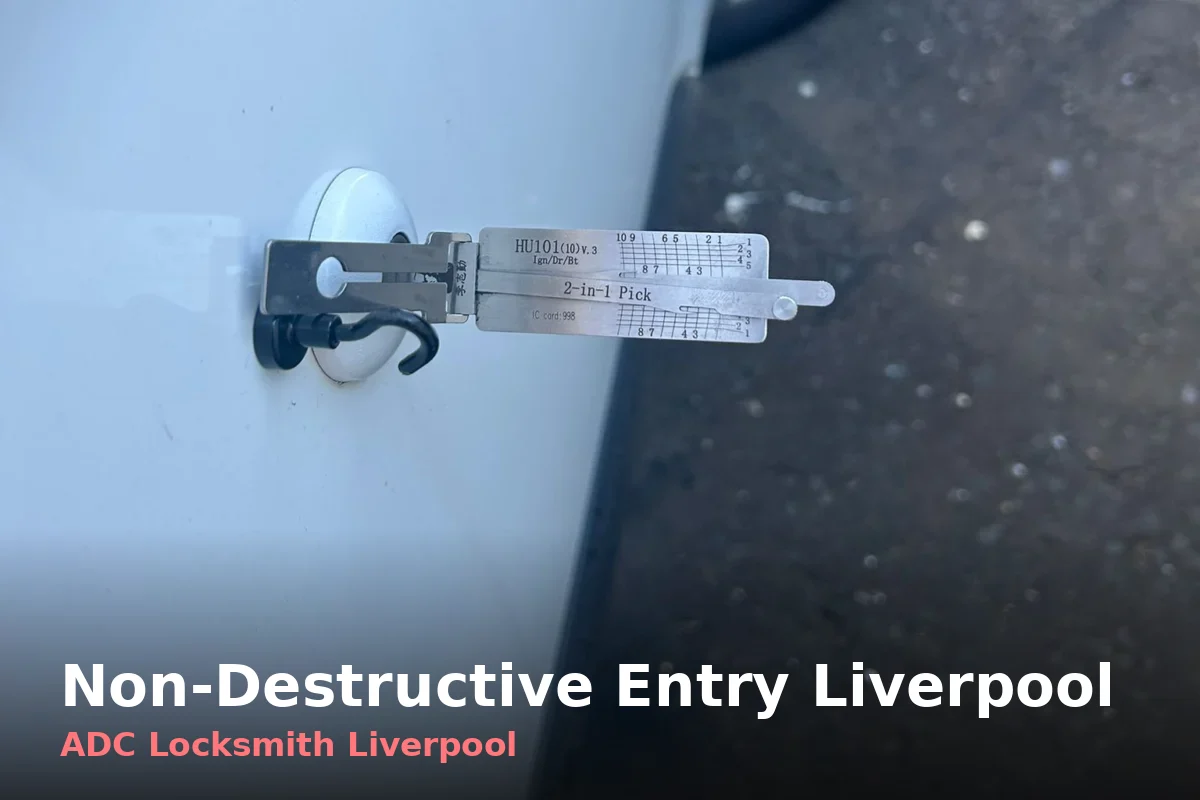
Non-destructive entry is a method of opening a locked vehicle by reading or manipulating the lock mechanism, with no drilling, no forcing and no broken glass. The pins inside the cylinder, the gap at the door seal and the linkage to the central locking motor are worked with tools made for that purpose.
The term is a technical standard and not a marketing phrase. The lock, the door and the glass are in the same condition after the entry as before it, and the original key still works. ADC Locksmith Liverpool works as a 24/7 mobile auto locksmith in Liverpool, so the entry happens where the vehicle is parked.
Every tool in the van is matched to a specific lock. Some read the pins inside a cylinder, some create a controlled space at the door and some work through the seal. The lock type of the vehicle decides the tool, and guesswork does not.
Five Non-Destructive Entry Methods by Lock
Non-destructive entry uses five methods, and the lock type of the vehicle decides which one applies. Three work on the lock itself and two work through the door.
| Method | Lock or vehicle | How the vehicle is opened |
|---|---|---|
| Lock picks | Door locks with a cylinder, on most cars and vans | The pins or wafers inside the cylinder are read and lifted one at a time until the lock turns |
| Decoder tools | High security and laser cut locks | The cut depths of the lock are measured, and the same reading allows a key to be cut afterwards |
| Air wedges | Framed doors with electric central locking | A padded bag opens a controlled gap at the top of the door with no pressure on the paint or the glass |
| Long reach tools | Vehicles with an interior handle or unlock button in reach | A coated rod passes through the gap made by the wedge and works the handle or the button |
| Wedge and rod | Older vehicles with mechanical locks | A slim wedge and a rod lift the lock button or the linkage inside the door |
Lock picks and decoder tools leave the door closed until the lock turns, so they are the first choice where the lock allows. Air wedges and long reach tools are used on vehicles where the cylinder is shielded or absent.
Non-Destructive Entry Against Forced Entry
Non-destructive entry leaves the vehicle unmarked, and forced entry leaves a repair. Modern lock cylinders are built to resist picking and forcing alike, so a rushed attempt damages the lock before it opens it.
| Part of the vehicle | Non-destructive entry | Forced entry |
|---|---|---|
| Glass | Untouched | A broken window, new glass and a clean up inside the car |
| Lock cylinder | Left fully working with the original key | Drilled out and replaced, often with the whole unit |
| Door panel and trim | Not removed and not levered | Cracked trim and broken clips from a pry bar |
| Paint and door seal | No mark, the wedge is padded | Scratched paint and a torn seal from a slim metal strip |
| Cost after the entry | None, the method is included in the price | A repair that often costs more than the lockout itself |
Forced entry is never used by ADC Locksmith Liverpool to save time. The business holds SERMI approval, under the scheme that controls access to the security data of participating manufacturers.
Both methods end with an open door. The difference is the state of the lock, the glass and the door after non-destructive entry.
Jobs That Start With Non-Destructive Entry
Non-destructive entry is not a standalone booking. It is the technique underneath other jobs, and it carries no charge of its own. The most common job is an emergency vehicle lockout, with the keys locked inside, the engine running or a child or a pet in the car.
The same entry comes first where a key has snapped in the ignition or a door lock. The vehicle is opened before the broken piece is extracted. A lost key job starts the same way, since the car has to be open before a new key is cut and programmed.
Entry is also the first diagnostic step on a lock or a central locking fault. The vehicle is opened safely, the fault is confirmed at the door and the repair is decided afterwards. Each of these services has its own page, listed under the related services.
Starts With Entry
- Keys locked in the car or the boot
- Key snapped in a door lock or the ignition
- All keys lost, with the car locked
- Central locking fault or a flat battery
- Child or pet inside, after a 999 call where at risk
How a Non-Destructive Entry Visit Runs
A non-destructive entry visit follows four steps, and the vehicle is usually open within five to twenty five minutes of arrival.
The price agreed on the call is the price on completion, however long the lock takes.
- 1Ownership is checkedPhoto identification and a link to the vehicle are seen before any tool touches the car.
- 2The lock is identifiedThe registration and a look at the door show the lock type and if deadlocks are set.
- 3The tool is matchedA pick, a decoder or a wedge with a long reach tool is chosen for that lock and no other.
- 4The vehicle is opened and checkedThe door, the seal, the paint and the lock are checked with the driver once the car is open.
Where Non-Destructive Entry Takes Longer
Non-destructive entry works on the vast majority of vehicles, and a straight answer is more useful than a blanket promise. A small number of newer vehicles use anti-theft locking systems designed to resist any manipulation of the mechanism, by design and not by flaw.
Entry on these vehicles takes longer than a standard job. In rare cases a tool specific to the manufacturer or a different approach is required, and the driver is told so before the work goes ahead and not after it.
A destructive method is never substituted to save time. Where a job takes longer or calls for a different tool, that is what happens, and the price agreed on the phone still holds.
Takes Longer
- Deadlocks set from the remote
- High security cylinders with shields
- Vans with added deadlocks or slam locks
- Locks already damaged by a forced attempt
Non-Destructive Entry Cost in Liverpool
Non-destructive entry in Liverpool costs from £85 with ADC Locksmith Liverpool, as the price of a vehicle lockout. The method adds nothing to any job, and no call out fee and no VAT apply.
| Job | What the entry covers | Price |
|---|---|---|
| Vehicle lockoutCars, most vans and boots | The vehicle is opened by non-destructive entry and checked with the driver | From £85 |
| Entry before a broken key repairA key snapped in the lock or the ignition | The entry is part of the repair and carries no charge of its own | Included |
| Entry before a replacement keyAll keys lost, with the car locked | The entry is part of the key job and carries no charge of its own | Included |
| Time of day and distanceNights, weekends and the edge of the area | The exact price reflects the hour and the travel, stated before Craig sets off | Confirmed on the call |
The price of a lockout is the same whichever of the five methods opens the vehicle. The quote on the phone is the invoice.
Related Services and Areas Covered in Merseyside
Related Services
The service pages carry the pricing and the process for each job that starts with entry.
A locked car is opened day or night.
A snapped key is extracted and the chip is re-housed.
A lost, stolen or broken key is replaced at the car.
Frequently Asked Questions About Non-Destructive Entry
Is non-destructive entry possible on every car?
Yes, on the large majority.
A small number of newer anti-theft locking systems take longer, and a few call for a tool specific to the manufacturer. The driver is told on the call or at the car before any work starts, and nothing is forced to save time.
Does non-destructive entry cost extra compared to a normal lockout?
No. Non-destructive entry is not an add-on, and it is how every entry job is done.
The price quoted for a lockout already includes it, and no surcharge is added for the method.
How much does non-destructive entry cost in Liverpool?
Non-destructive entry in Liverpool costs from £85 with ADC Locksmith Liverpool, as the price of a vehicle lockout. No call out fee and no VAT apply, and the exact price is confirmed on the call before travel.
How long does non-destructive entry take compared to forced entry?
Non-destructive entry takes a few minutes longer than forced entry on most vehicles, and usually between five and twenty five minutes at the car. It avoids the bill for new glass, a cracked panel or a replaced lock cylinder.
Does the entry method matter to an insurer?
Sometimes. Non-destructive entry leaves no evidence of forced access, which occasionally matters for a later claim.
Forced entry is visible and unambiguous, and the repair is a cost of its own.
Does non-destructive entry work on older vehicles as well as new ones?
Yes. Older vehicles with mechanical locks respond well to the wedge and rod method.
Newer vehicles with electronic central locking are opened with lock picks and decoder tools. The lock type decides the tool, and the age of the vehicle alone does not.
Is a lock fault found during non-destructive entry?
Often, yes. Opening the vehicle is frequently the first step in the diagnosis of a central locking fault.
Anything noticed at the lock or the door is reported plainly at the car, so the driver knows if a repair is worth booking.
Is proof of ownership checked before a vehicle is opened?
Yes. Photo identification and a link to the vehicle, such as the registration document or an insurance record, are checked before entry.
The check protects every owner, and it is part of the standard that ADC Locksmith Liverpool holds under its SERMI approval.
Which vehicles are opened by non-destructive entry?
Cars, vans and boots from most makes on the road are opened by non-destructive entry. The lock type differs from one manufacturer to the next, so the registration is taken on the call. The full list sits on the page for car makes.
Does a flat car battery stop non-destructive entry?
No. A flat battery disables the central locking and the remote, and the mechanical door lock still works.
The lock is picked and turned in the usual way, and the door opens with no power in the vehicle.
Who carries out non-destructive entry?
Craig Evans, the owner, answers the call and opens the vehicle. No call centre and no subcontractor is involved. The training and the checks behind the work are set out on the page about Craig Evans.
Non-destructive entry, included in every lockout, usually in about 30 minutes. No call out fee, no VAT.