A car key stuck in the ignition is usually held by a gear lever short of Park, a steering lock under load or a flat car battery, and the key slides out without force once that cause is cleared.
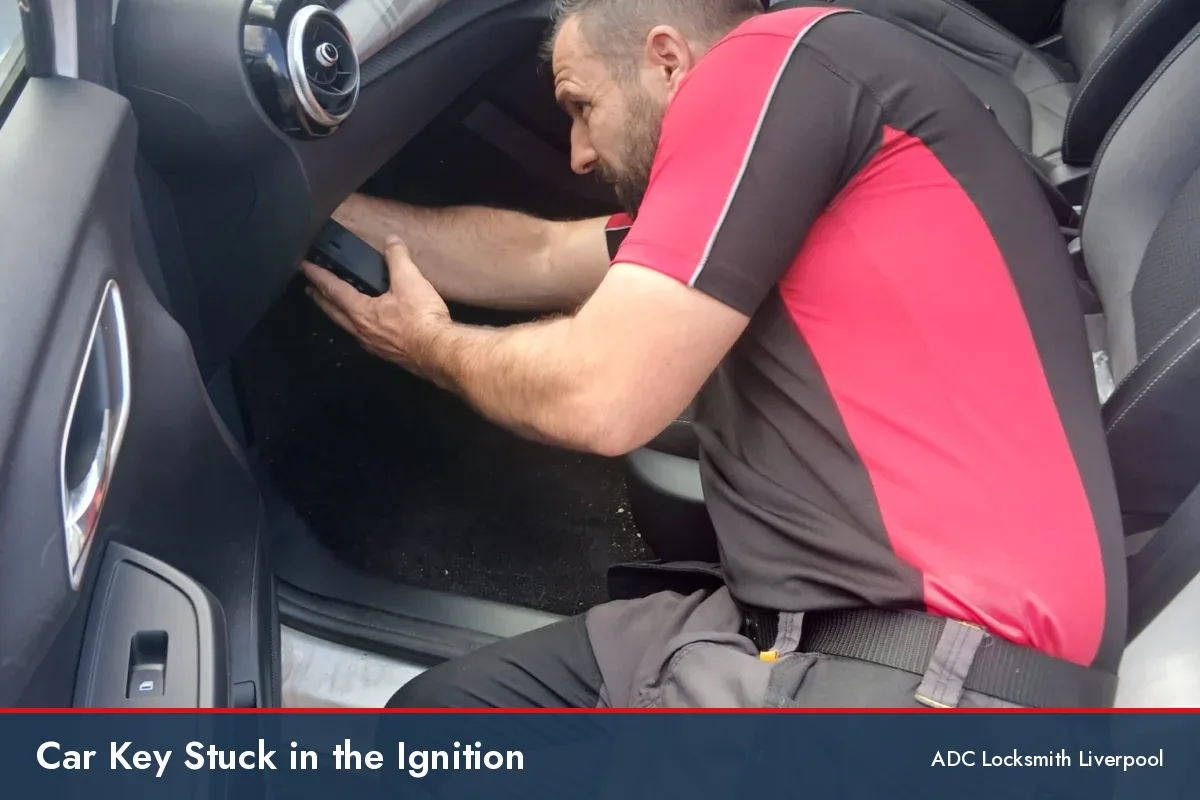
A stuck ignition key is a key that the ignition barrel holds after the engine stops, so the blade neither turns back to the off position nor slides out. The barrel releases the key only when the wafers inside line up with the key cuts, the steering lock is free and, on an automatic, the gear lever rests in Park. Six checks free most keys in under five minutes, and seven causes explain the rest, four from the way the car was parked and three from wear. An auto locksmith removes a key stuck in the ignition in 30 to 60 minutes at the car, and the removal costs £60 to £150 across the UK. Force is the one mistake that turns a stuck key into a snapped blade and a larger bill.
The car not starting, a flat car battery, battery drain, WD40, automatic cars, the override, a locked steering wheel, a running engine, the cars affected, a new ignition barrel, locksmith time, safety, a worn key, the only key, a snapped key and a key fob in the slot raise sixteen further questions.
The list below gives four key takeaways on a car key stuck in the ignition.
- A gear lever pushed fully into Park releases the key on most automatic cars.
- A steering wheel rocked left and right frees a key held by the steering lock.
- A flat car battery holds the key on an automatic until a jump start restores power.
- An auto locksmith removes a key that six checks leave stuck, without a new ignition barrel in most cases.
Which 6 checks free a stuck ignition key?
Six checks free a stuck ignition key, and each check works from the driver seat with no tools and no force. The list below gives the six checks in order.
- Push the gear lever fully into Park on an automatic with the foot brake pressed, or select neutral with the handbrake on in a manual car.
- Turn the key back to the off position, marked 0 or LOCK, since the barrel releases the key in that position only.
- Rock the steering wheel a few millimetres left and right while turning the key toward off, which lifts the load from the steering lock.
- Press the key toward the barrel during the last part of the turn, or press the release button beside the barrel where the car has one.
- Check the dashboard lights and jump start a flat car battery, since the key release on an automatic runs on battery power.
- Ease the key out with a light up and down movement after one short burst of dry lock lubricant into a gritty barrel.
Checks one to four free most keys in seconds, and check five frees an automatic with a dead dashboard. A key stuck in the ignition after all six checks points to wear inside the barrel or on the blade, and pulling harder from that point snaps the key.
Why does a key stick in the ignition?
A key sticks in the ignition because the barrel releases the blade only in the off position, with the steering lock free and the gear lever in Park. The list below gives seven causes, four from the way the car was parked and three from wear.
- A gear lever short of Park keeps the shift interlock closed, and the interlock holds the key on an automatic car.
- A steering lock under load pins the barrel, which happens where a front wheel rests against a kerb or the steering wheel was pulled after the engine stopped.
- A key left in the accessory position sits one click short of off, where the barrel grips the blade.
- A flat car battery, also called a dead battery, cuts the power to the key release solenoid on an automatic.
- A worn or bent key has rounded cuts that no longer lift the wafers level.
- A worn ignition barrel has brass wafers that wear down after years of starts, often past 100,000 miles (160,000 km).
- A dirty barrel holds lint, grit or a dried spilled drink between the wafers.
The first four causes break nothing and clear from the driver seat. The last three causes are wear, and a key stuck in the ignition through wear returns until the key or the barrel is repaired. Each cause leaves its own symptom at the key.
Which symptom matches which stuck key cause?
Each symptom matches one stuck key cause, and the feel of the key and the state of the steering wheel separate a parking cause from wear. The table below compares six symptoms of a key stuck in the ignition.
| Symptom | Likely cause | First action |
|---|---|---|
| The key turns to off and stays held in an automatic | Gear lever short of Park | Press the foot brake and push the lever into Park |
| The key and the steering wheel are both locked solid | Steering lock under load | Rock the wheel while turning the key |
| The key stops one click before off | Key in the accessory position | Press the key in and complete the turn |
| The dashboard is dead and the key stays held | Flat car battery | Jump start or charge the battery |
| The key feels gritty and sticks on some days | Worn key, worn barrel or dirt | Use dry lock lubricant and book a locksmith |
| The key is bent or cracked at the shoulder | Damaged blade | Stop turning and call an auto locksmith |
Rows one to four are parking causes with a fix that costs nothing. Rows five and six are wear, where force is the fastest way to make a stuck ignition key worse.
What makes a stuck ignition key worse?
Force, oil and delay make a stuck ignition key worse, and each one adds a repair that the stuck key alone never called for. The list below gives five mistakes.
- Pulling hard or gripping the key with pliers snaps the blade at the shoulder and leaves a fragment in the barrel.
- Spraying an oil such as WD40 into the barrel leaves a film that gathers dust on the wafers.
- Hammering or pushing the key deeper bends the wafers, and bent wafers end in a new barrel.
- Leaving the key in the accessory position flattens the car battery overnight.
- Booking recovery to a garage first adds a tow fee before anyone has looked at the key.
A snapped blade turns a key stuck in the ignition into a broken car key repair, with an extraction before any other work. A locksmith called before that point removes the key whole.
How does a locksmith remove a stuck key?
A locksmith removes a stuck key by freeing the steering lock, lubricating the barrel and lining up the wafers with a fine extraction tool until the blade slides out whole.
The work happens at the car, with no tow and, in most cases, with the steering column left intact. The locksmith then reads the blade for wear, turns the barrel through every position and cuts a new key to the key code where the old cuts are rounded. The same tools serve broken car key repairs in Liverpool, where ADC Locksmith Liverpool extracts a snapped blade from the ignition from £70 with no call out fee and no VAT. Craig Evans removes a key stuck in the ignition in 30 to 60 minutes and reaches most Liverpool addresses in about 30 minutes, 24 hours a day.
How much does stuck ignition key removal cost?
Stuck ignition key removal costs £60 to £150 across the UK with a mobile auto locksmith, and the price rises only where the key or the barrel is worn out. The table below compares four jobs that follow a key stuck in the ignition.
| Job | Price | Time |
|---|---|---|
| Stuck key removed whole | £60 to £150 across the UK, from £70 in Liverpool | 30 to 60 minutes |
| Snapped key extracted with the chip moved to a new blade | From £110 in Liverpool | About 60 minutes |
| Ignition barrel replaced by an independent specialist | £150 to £400 | 30 to 90 minutes |
| Ignition barrel replaced by a main dealer after recovery | £400 to £800 plus a tow of £100 to £300 | Often several days |
Most stuck keys end at the first row. ADC Locksmith Liverpool gives a fixed price on the call, before travel, with no call out fee and no VAT.
What stops a key sticking in the ignition?
Five habits stop a key sticking in the ignition, and a light keyring and a fresh key cut protect the barrel wafers best. The list below gives the five habits.
- Keep the keyring light, since a heavy bunch swings on the blade and wears the wafers.
- Replace a worn key through car key cutting to the key code, since a copy of a worn key repeats the wear.
- Straighten the front wheels and release the steering wheel before the engine is switched off.
- Select Park and wait for the lever to settle before the key is turned to off.
- Keep a spare car key at home, so one worn blade never leaves the car without a key.
A key that starts to catch is the early warning. A recut key at that stage costs less than any removal of a key stuck in the ignition.
What else do drivers ask about stuck keys?
Drivers ask about stuck keys in sixteen further questions on a key stuck in the ignition. The car not starting, a flat car battery, battery drain, WD40, automatic cars, the override, a locked steering wheel, a running engine, the cars affected, a new ignition barrel, locksmith time, safety, a worn key, the only key, a snapped key and a key fob in the slot are the sixteen topics, and the questions below answer each one.
Frequently asked questions
Why is the key stuck in the ignition and the car not starting?
The key is stuck in the ignition and the car does not start because the steering lock is under load or the car battery is flat.
A rocked steering wheel frees the first, and a jump start cures the second.
Does a flat car battery trap a key in the ignition?
Yes, a flat car battery traps a key in the ignition on an automatic, since the key release has no power.
The doors stay locked too, and unlocking a car with a dead battery starts at the door keyhole.
Does a key stuck in the ignition drain the battery?
Yes, a key stuck in the ignition drains the battery where the key rests in the accessory or on position.
The radio, the dashboard and the control units stay powered and flatten a healthy battery overnight.
Does WD40 free a key stuck in the ignition?
No, WD40 does not free a key stuck in the ignition for long, since the oil film gathers dust on the wafers.
A dry graphite or PTFE lock lubricant is the product made for an ignition barrel.
Why is a key stuck in the ignition of an automatic car?
A key is stuck in the ignition of an automatic car because the gear lever sits short of Park.
The shift interlock holds the key until the Park switch closes, so a firm push of the lever releases it.
Is there an override to remove a key from the ignition?
Yes, an override to remove a key from the ignition exists on many automatic cars, a manual release behind a small cap beside the gear lever or under the column shroud.
The handbook lists it under shift lock release.
Why is the key stuck in the ignition with the steering wheel locked?
The key is stuck in the ignition with the steering wheel locked because a turned wheel presses the lock bolt against the column.
The guide to a key not turning in the ignition covers the same steering lock.
What if the key is stuck in the ignition with the engine running?
A key stuck in the ignition with the engine running points to a failed ignition barrel or ignition switch.
Rule 123 of the Highway Code bans an unattended running engine on a public road, so the driver stays put.
Which cars get a key stuck in the ignition most often?
Cars with a bladed key and a high mileage get a key stuck in the ignition most often, since the barrel wafers wear with every start.
Older Ford, Vauxhall and Volkswagen models make up many of the cases.
Does a key stuck in the ignition mean a new ignition barrel?
No, a key stuck in the ignition does not mean a new ignition barrel in most cases.
A new barrel follows only where broken wafers or a seized lock caused the fault.
How long does a locksmith take to remove a stuck key?
A locksmith takes 30 to 60 minutes at the car to remove a stuck key from the ignition.
The journey adds about 30 minutes across Liverpool with ADC Locksmith Liverpool.
Is a car safe to leave with the key in the ignition?
No, a car is not safe to leave with the key in the ignition, since the doors stay unlocked to anyone passing.
Most motor insurers refuse a theft claim where the key was left in the car.
Does a worn key get stuck in the ignition?
Yes, a worn key gets stuck in the ignition because rounded cuts no longer lift the wafers level.
A new blade from car key cutting in Liverpool is cut to the key code and never copied from the worn key.
What happens when the only key is stuck in the ignition?
The only key stuck in the ignition leaves the car with no working key once the blade snaps.
A spare car key made at the same visit costs less than a replacement after every key is lost.
How much does removing a snapped key from the ignition cost?
Removing a snapped key from the ignition costs from £70 with ADC Locksmith Liverpool, and from £110 with the chip moved to a new blade.
UK prices run from £60 to £150 for the extraction.
Does a key fob get stuck in the ignition slot?
Yes, a key fob gets stuck in the ignition slot on cars with a fob dock where the car battery is flat.
The dock uses an electric latch, so a charged battery releases the fob.
Based in Liverpool and still stuck?
ADC Locksmith Liverpool repairs, programs and replaces car keys at the roadside across Liverpool and Merseyside, usually on the same day. Craig Evans holds SERMI approval and a 5.0 rating from 341 Google reviews. A call to 07731 544220 brings a fixed price before Craig travels.
Call 07731 544220